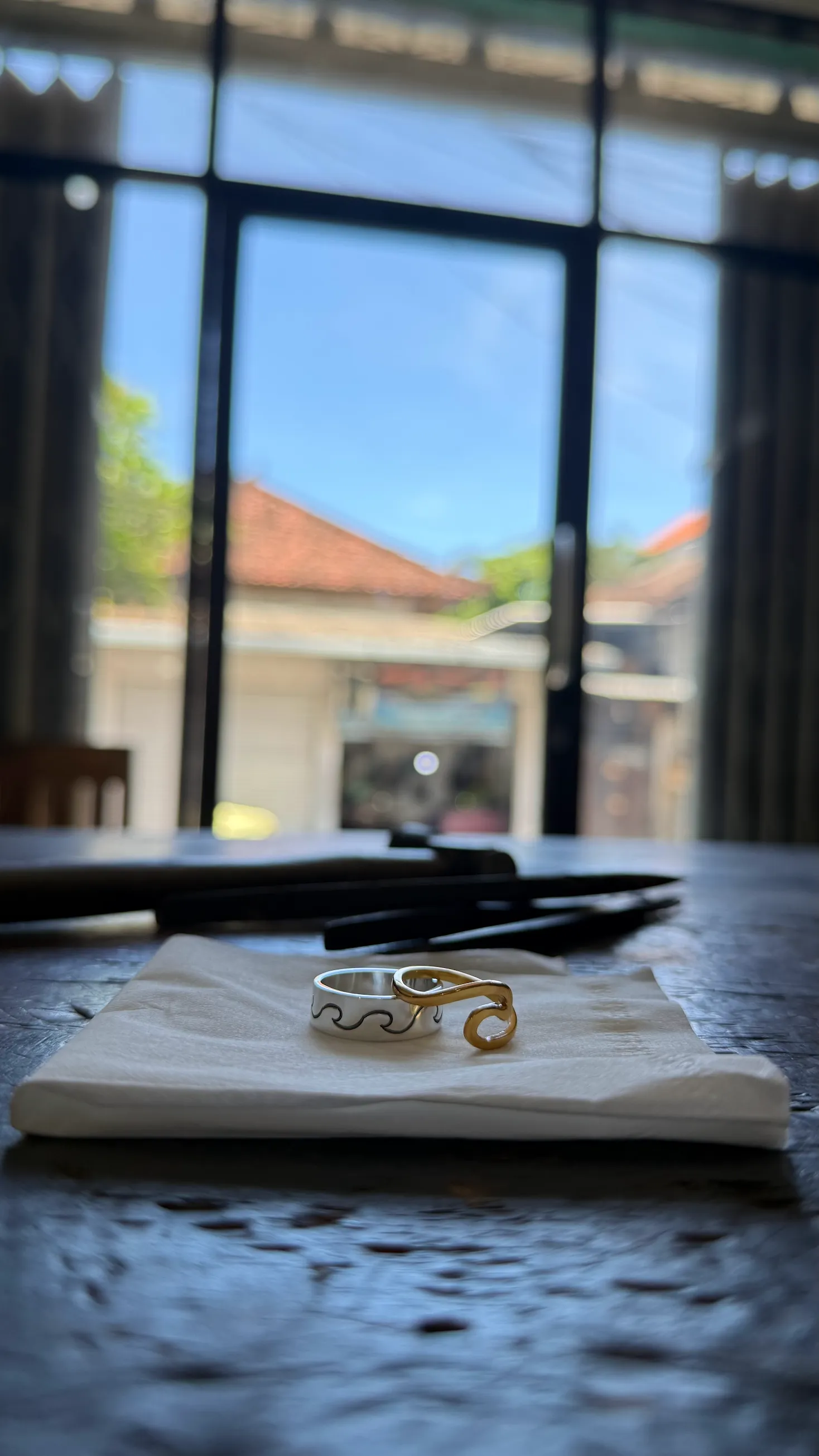
Finding the right ring size before your Bali silver workshop takes about five minutes. It prevents a loose or tight handmade ring. Use this silver ring sizing guide for your Bali workshop to measure your finger at home, convert between US, UK, EU and Australian sizes, and tell your instructor the fit you prefer before the crafting starts.
A handmade sterling silver ring should feel snug enough to stay put when you shake your hand, but loose enough to slide over the knuckle without pain. Bali workshops often use thicker silver bands, so sizing runs a little differently than thin commercial rings. Here's a practical step-by-step method using items you already own.
How to use this silver ring sizing guide for your Bali workshop
Measure your finger with one of the methods below, convert the measurement to a country-specific ring size using the chart, then bring that number or a well-fitting ring to Krisna Silver Class in Canggu. If you don't have time to measure at home, we can size you at the studio before any silver is cut.
What you will need
- A thin strip of paper, non-stretchy string, or a flexible measuring tape
- A ruler with millimeter markings
- A pen or marker
- An existing ring that fits the same finger, if you have one
Why ring size matters in a silver workshop
Most travelers arrive in Canggu without a ring sizer. That's normal. Silver, though, isn't as forgiving as gold or brass once it's soldered and polished. A ring that's too small may not clear your knuckle at all. A ring that's too large can slip off easily and feel uncomfortable in humid weather.
At Krisna Silver Class, your instructor can adjust the metal while it's still in wire or sheet form. After soldering, the size is mostly fixed. That's why we ask for your ring size at the start of class, not the end.
Common ring-fit problems
A ring that's too tight leaves a mark, is difficult to remove, and feels uncomfortable in heat. Too loose means it spins around the finger and can slide off when your hands are wet. Correct fit gives light resistance over the knuckle and sits comfortably at the base without gaps.
How to measure your ring finger at home
Honestly, most people overthink this. You don't need a professional tool. Use one of these three methods at least a few hours after waking, when your hands aren't swollen.
Method 1: String or paper strip
- Cut a thin strip of paper or use a piece of non-stretchy string about 10 cm (4 in) long.
- Wrap it around the base of the finger where the ring will sit.
- Mark where the strip overlaps with a pen or pencil.
- Lay the strip flat against a ruler and measure the length in millimeters.
- Divide that number by 3.14 to get the inside diameter. Then compare it to the chart.
Method 2: Existing ring
- Grab a ring you already wear on the same finger.
- Set it on a ruler and measure the inside diameter across the center, edge to edge.
- Note the measurement in millimeters.
- Compare that diameter with the conversion table below.
Method 3: Printable ring sizer
If you have a printer, download a free printable ring sizer from a reputable jeweler. Print it at 100% scale, cut the slit, and wrap it around your finger. Be careful: many printers default to 'fit to page,' which throws off the size.
Ring size conversion chart
Ring sizes vary by country. In Bali, most workshops use either US or Australian/UK sizing, depending on the instructor. Use this table to convert your measurement to the size you'll give your silversmith.
| Inside Diameter (mm) | US / Canada | UK / Australia | EU / France | Typical Finger | |----------------------|-------------|----------------|-------------|----------------| | 15.7 mm | 5 | J 1/2 | 49 | Small pinky | | 16.5 mm | 6 | L 1/2 | 52 | Ring finger (small) | | 17.3 mm | 7 | N 1/2 | 54 | Ring finger (average) | | 18.1 mm | 8 | P 1/2 | 57 | Middle finger / wider band | | 19.0 mm | 9 | R 1/2 | 60 | Index or middle finger | | 19.8 mm | 10 | T 1/2 | 62 | Thumb or large knuckle |
For wide silver bands (6 mm or more), many silversmiths recommend going up half a size from your usual thin-ring size. Talk with your instructor about your design before any metal gets cut.
Tips for getting the most accurate measurement
Your finger changes size through the day and with temperature. These rules help you avoid a surprise at the workshop.
- Measure in the late afternoon or evening, not first thing in the morning.
- Don't measure right after exercising, eating salty food, or drinking alcohol. All of those can cause swelling.
- If your knuckle is much larger than the base of your finger, measure both and pick a size between them.
- Take three measurements and use the middle value.
- If you're between sizes, round up to the nearest quarter or half size, especially for wide bands.
- Bring a ring that fits that finger if you have one. Your instructor can match it directly.
Why finger size changes in Bali
Bali's tropical climate can make fingers swell a little, especially after walking in the sun, eating salty Indonesian food, or drinking alcohol. Humidity alone won't change your ring size. Heat and salt will. Measure when you feel cool and rested, and avoid measuring right after a long flight.
What we do differently at Krisna Silver Class
Our open-air studio in Canggu gives you time to check your size before any silver gets cut. We keep a set of metal ring sizers and mandrels on hand, and we'll have you try a plain sample ring before you start forming your own.
If you're traveling solo, the single silver class covers ring sizing and basic forming in one relaxed session. Couples can make two rings side by side in the couple silver class. Families with children who want a shared creative activity can choose the family silver class. No matter which class you pick, your instructor will confirm your ring size before any metal is cut.
Ring styles and fit notes
Classic flat bands fit true to size, so use your normal ring size. Hammered bands run slightly thicker, so consider half a size up if your knuckle is large. Twisted or braided rings may fit a little looser because of the texture. Keep your standard size. An adjustable wrap ring is easier to resize after class if you're unsure. For signet or wide bands, go up half to one full size from your normal ring size.
Your instructor will help you choose a design that matches both your skill level and your finger shape.
What to expect on workshop day
On workshop day, arrive with clean, dry hands. Remove any rings from the finger you're sizing, especially if they're tight. Your instructor will confirm your size with a metal ring sizer and may ask you to slide a plain sample ring over the knuckle.
Then you'll choose your silver stock, measure it against the mandrel, cut, file, solder, and polish. Since the size is set before soldering, small adjustments are much easier during cutting and forming. If the sample ring feels too loose or too tight, speak up right away. An extra two minutes on sizing beats leaving with a ring that doesn't feel right.
Frequently asked questions
What if I don't know my ring size before the workshop?
You don't need to know it in advance. Our studio has metal ring sizers, and your instructor will measure your finger at the start of class. Measuring early just saves time and helps you choose a design faster.
Can I make a ring if my finger swells in Bali's heat?
Yes. Measure your finger in the afternoon and avoid measuring right after walking in the sun or eating salty food. If your finger size changes during the day, choose a size that fits comfortably over the knuckle and add half a size for a wide band.
What size should I choose for a wide silver band?
For bands 6 mm or wider, most silversmiths recommend going up half a US size from your standard thin-ring size. If you're between sizes, round up rather than down.
Can I resize my silver ring after the class?
It depends on the design. A simple band can sometimes be stretched or compressed slightly, but rings with stones, heavy texture, or soldered joins are harder to resize. Talk to your instructor about your design before cutting.
Do I need to bring a ring that already fits?
It's helpful but not required. A well-fitting ring lets your instructor match the inside diameter directly, which is often more accurate than a home measurement.
Is there a class for absolute beginners who have never made jewelry?
Yes. The single silver class is designed for beginners, and we cover measurement, shaping, soldering, and polishing step by step. No previous experience is needed.
Conclusion
A few minutes of prep with this silver ring sizing guide for your Bali workshop can be the difference between a ring you wear every day and one that sits in a drawer. Measure your finger in the afternoon, use a conversion chart if you're coming from overseas, and tell your instructor whether you prefer a snug or loose fit.
If you want a ring that fits perfectly, book a silver class at Krisna Silver Class in Canggu and make your own sterling silver ring with local silversmiths.