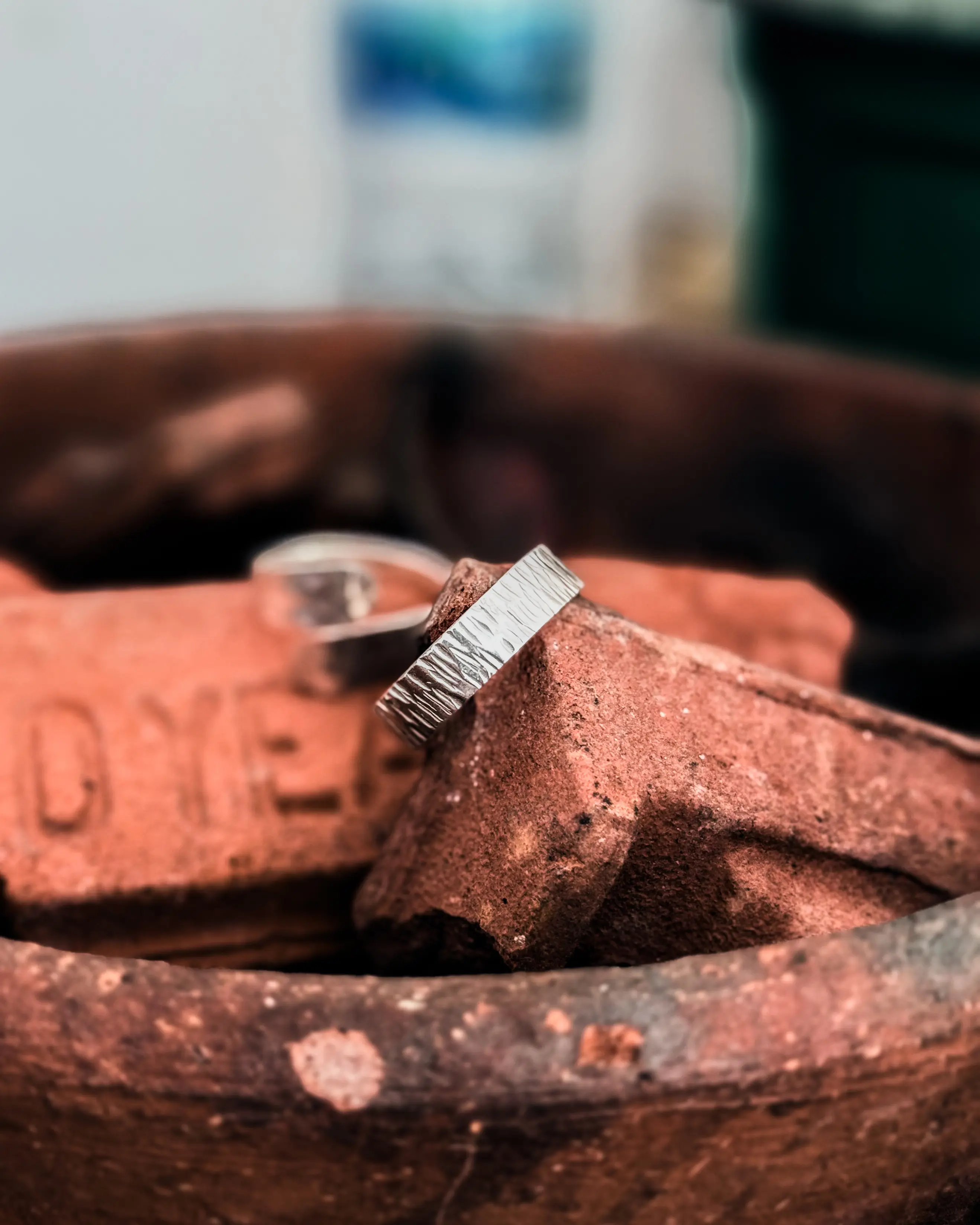
Hammered and polished sit at opposite ends of the ring texture spectrum. Honestly, most people overthink this. One finish hides scratches. The other puts them on display. The right pick depends on how much shine you want, how often the ring stays on your finger, and how much upkeep you'll actually do.
A hammered finish gives you a faceted, organic sparkle and hides scratches well. A polished finish is smooth and mirror-like, shows every mark, and can be re-polished. You'll want to settle on the texture before you sit down at the workbench in Canggu.
What is a hammered finish?
A hammered finish is exactly what it sounds like. Sterling silver gets struck with a textured or ball-peen hammer, and each hit leaves a small dent or facet. The surface ends up dimpled and handcrafted, covered in tiny reflective spots. No two rings come out the same. Hammer size, strike force, and spacing all shift the pattern. Hammering also work-hardens the silver a bit, so the band can feel firmer. Light hits the surface from a bunch of angles, giving you scattered sparkle instead of one continuous mirror shine.
People drawn to a handmade look that ages well usually pick hammered. The surface already has irregularity built in, so new dings or fine scratches blend in instead of shouting for attention.
What is a polished finish?
A polished finish comes from sanding silver with progressively finer abrasives, then buffing it with polishing compound. The metal becomes smooth to the touch and highly reflective. At a quick glance, a polished sterling silver ring can pass for white gold or platinum. It also picks up fingerprints, hairline scratches, and everyday wear much faster than a hammered surface. You can maintain it at home with a soft silver-polishing cloth, though deeper scratches usually need re-buffing.
Choose polished if you like a clean, classic, formal look and don't mind periodic upkeep. It's also the best base for a high-shine contrast against a textured area.
Hammered vs polished finish: side-by-side comparison
Here's how the two finishes compare.
| Feature | Hammered Finish | Polished Finish | |---|---|---| | Appearance | Organic, faceted, handmade | Smooth, mirror-like, formal | | Sparkle | Subtle, scattered light | Strong, continuous reflection | | Hides scratches | Excellent | Poor | | Fingerprint visibility | Low | High | | Maintenance | Very low | Moderate to high | | Feel on skin | Lightly textured | Very smooth | | Best for | Casual, rustic, everyday wear | Formal, minimalist, occasional wear |
How to choose based on your lifestyle
Your daily routine matters more than any trend. Go with hammered if you work with your hands or wear the ring every day. Hammered also makes sense if you prefer low maintenance, like handmade jewelry, or plan to stack the ring with other textured bands. Go polished if you want a sleek, classic ring for formal or office wear. It's also the right call if you don't mind wiping it to keep it shiny, prefer a smooth feel against adjacent fingers, or want a clean base for a gemstone or engraving.
If you're making a couple's set, one partner may prefer hammered and the other polished. The two finishes sit well together because the contrast makes each texture more noticeable. At a couple silver class, you can make two rings with different finishes and compare them side by side.
How the finish changes during hand fabrication
When you make a ring from sterling silver wire or sheet, the finish comes near the end, after forming, soldering, and sizing.
In a hands-on workshop, the order usually goes like this:
- Measure and cut the silver.
- Shape the band around a mandrel.
- Solder the join if needed.
- File and sand the surface.
- Choose a texture: leave it smooth and move to polishing, or hammer it before final finishing.
A hammered finish often goes on with a small ball-peen or cross-peen hammer after the ring is formed. Hammering can slightly change the ring's shape, so the instructor usually checks the size again before final polish. In a single silver class, beginners learn both techniques on scrap silver before committing to their ring.
A polished finish requires more sanding time. You work through several grits of sandpaper to remove file marks, then buff the ring on a polishing wheel. It's straightforward but takes patience.
Hammered and polished combinations
You don't have to commit to a single finish. Many handmade rings combine textures. Half and half means polishing the top half of the band and hammering the lower half, or polishing the edges and hammering the center. Accent lines mean hammering the main band, then polishing a thin border along each edge. Selective hammering means hammering one small section of the ring and leaving the rest polished. Mixed metals means practicing texturing on brass before deciding how to finish a silver piece.
Combining finishes is a good way to personalize your ring. The polished areas still need more upkeep, but the overall design can hide wear on the hammered sections.
Caring for hammered and polished rings
Both finishes are easy to care for, but they have different needs.
Hammered ring care
- Wash with mild soap and warm water, then pat dry.
- Use a soft toothbrush to clean inside the hammered dimples.
- Avoid abrasive cloths that could flatten the texture over time.
- Store in a fabric-lined box or separate pouch.
Polished ring care
- Wipe with a dry silver-polishing cloth after each wear.
- Avoid contact with perfume, lotion, and chlorine.
- Buff gently when fine scratches appear.
- For deeper scratches, have the ring re-polished by a silversmith.
Sterling silver naturally tarnishes over time, especially in humid climates like Bali. A hammered finish may show tarnish as a darker patina in the recesses, which many people like. A polished finish shows a more even tarnish film that wipes away easily.
Making the decision at a Canggu Silver Class
If you're still unsure which texture to choose, the easiest way to decide is to test both on a small piece of silver. At Krisna Silver Class in Canggu, you can try hammering and polishing techniques before you commit to the final ring design.
We tell every student to try both on scrap first. Most have a clear favorite within minutes. Instructors show you how to hammer evenly and buff without overheating the metal. You can make a simple band first, then decide whether to leave it polished or add hammer texture. Families and groups can share finishing tools and compare results during the same session. The relaxed open-air studio gives you time to choose without pressure.
When you book a silver class, you don't need any jewelry experience. The class is designed for beginners, and the instructor helps you choose a finish that matches your style and lifestyle.
For a solo experience, a single silver class gives you one-to-one guidance on texture choices. If you're visiting with friends, a group silver class is a fun way to compare finished rings.
Frequently asked questions
Can I combine hammered and polished finishes on one ring?
Yes. You can polish the edges and hammer the center, hammer the lower half and polish the top, or add a polished border around a hammered band. Mixing the two adds contrast and makes the ring feel more like yours.
Does a hammered finish make a ring more durable?
Not structurally. A hammered finish doesn't change the tensile strength of sterling silver much, but it makes surface wear far less visible. The indentations hide scratches that would be obvious on polished silver. Hammering can slightly work-harden the metal, but the real benefit is less visible maintenance.
Will a polished finish stay shiny forever?
No. A polished sterling silver ring develops fine scratches and tarnish over time, especially with daily wear. You can restore the shine at home with a silver-polishing cloth. If it needs more work, a jeweler or silversmith can re-buff the surface.
Which finish is better for a wedding band?
There's no single best finish. A hammered wedding band is more forgiving for daily wear and hides scratches well. A polished band looks more formal and classic but needs cleaning more often. Plenty of couples choose one of each to match their own preferences.
Can beginners create a hammered finish in a single silver class?
Yes. Hammering is one of the easiest finishing techniques for beginners because you don't need a perfect surface. In a single silver class, the instructor shows you how to strike the silver with controlled, overlapping hits to create an even texture.
How do I care for a hammered ring vs a polished ring?
A hammered ring needs mild soap, water, and an occasional light brushing inside the dimples. A polished ring does best with regular wiping using a silver-polishing cloth and storage away from damp air. Both should stay away from harsh chemicals and prolonged chlorine exposure.
Choose the texture that feels right
Both hammered and polished finishes look great on sterling silver. The right one depends on your daily habits, your style, and how much upkeep you'll actually do. If you want a low-maintenance ring with an organic, handmade look, choose hammered. If you want a sleek, mirror-like finish and don't mind occasional polishing, choose polished. You can also combine the two for a ring that's all yours.
The best way to make the final decision is to feel the textures in your hands. Book a silver class at Krisna Silver Class in Canggu and create a ring you'll actually wear every day.